

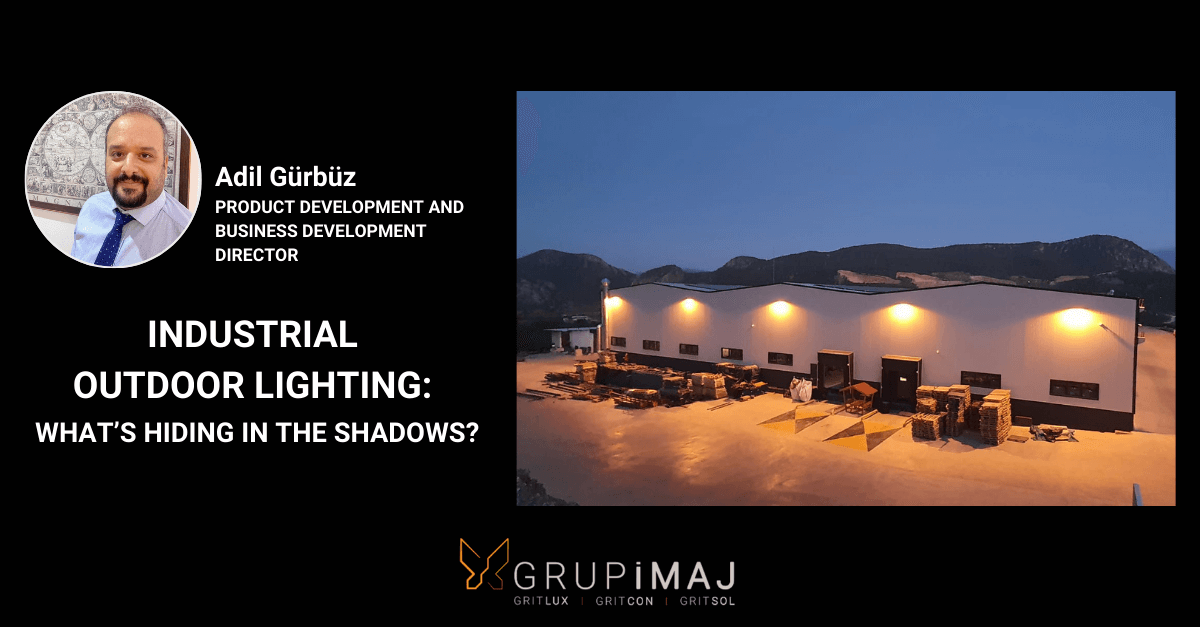
INDUSTRIAL OUTDOOR LIGHTING: WHAT’S HIDING IN THE SHADOWS?
If you asked someone on the street what the most effective outdoor lighting is, they’d probably say it should be as bright as possible. Unfortunately, they’d be wrong.
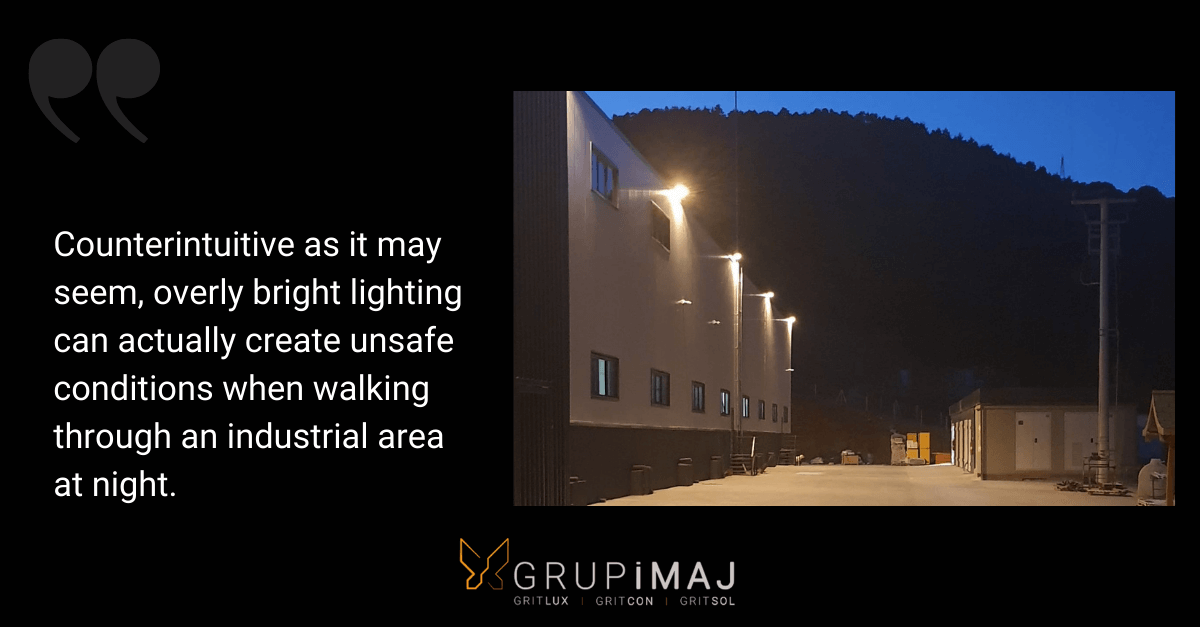
Counterintuitive as it may seem, overly bright lighting can actually create unsafe conditions when walking through an industrial area at night. Here’s why excessive brightness can compromise the safety of your employees and visitors—and why a lower, well-designed lighting level is often the smarter choice.
Too Much Contrast and Light Can Actually Make It Harder to See
Imagine working on your computer in a dark room. Your monitor may be bright enough to see what you’re doing, but it can make it difficult to notice what’s happening in the rest of the space—even if the room isn’t pitch black.
The same thing happens outdoors: you can see what’s inside the lit zone, but it becomes difficult to see anything beyond that radius. Very bright light—especially when paired with glare from reflective surfaces—can prevent you from seeing your surroundings clearly. Navigating a parking lot can be challenging when light bounces off windshields, glossy paint, and building windows.
Another hazard created by bright lighting is shadowing. Unless an area is uniformly lit with floodlights, some spots will naturally fall into relative darkness. That can create situations where, for example, a potential thief can hide in the shadows beside parked cars.
It’s true that the human eye adapts to changes in light fairly quickly. But when it comes to the safety of your staff and guests, “fairly quickly” isn’t good enough.
Industrial Outdoor Lighting and the Surrounding Environment
When deciding on the right configuration and light levels, many people forget to consider the environment just beyond their site. How are nearby streets lit? What about side roads or green areas?
The areas outside your industrial zone may be much more dimly lit than your facility. Beyond high-traffic sections, there may be only an occasional streetlight to guide pedestrians.
And again, the issue is shadows. If your lighting is far brighter than the surrounding area, it can create pockets of darkness where ill-intentioned individuals can conceal themselves—putting people at risk.
Seven Reasons LED Makes Sense for Industrial Applications
1) Energy Efficiency
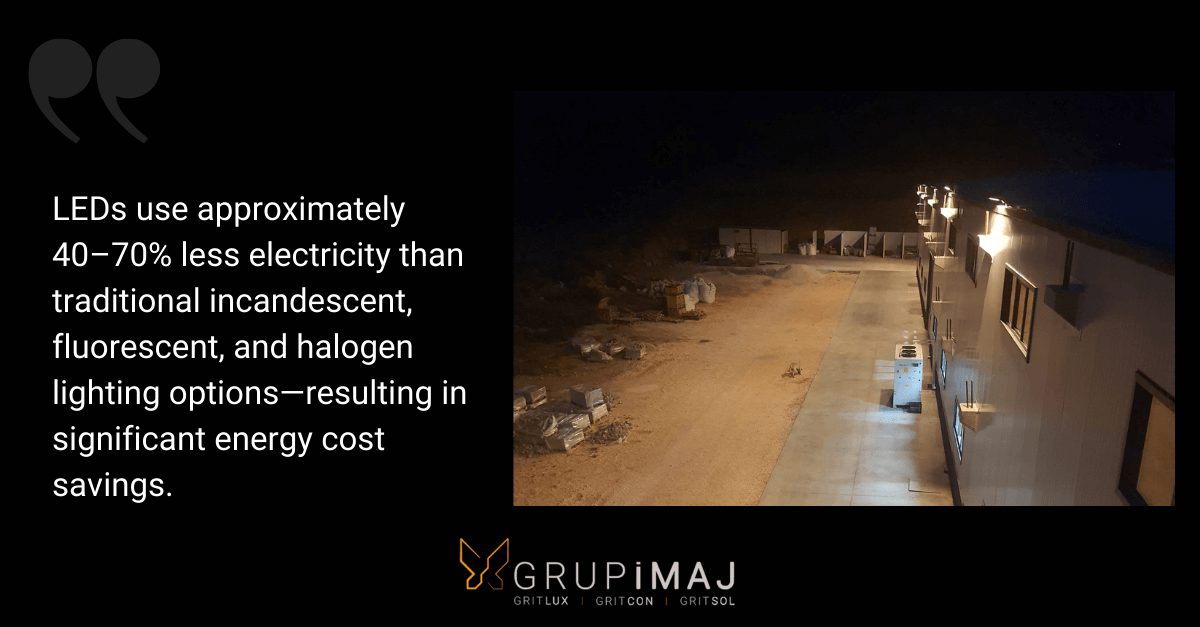
LEDs use approximately 40–70% less electricity than traditional incandescent, fluorescent, and halogen lighting—leading to significant energy cost savings. These savings grow even more in applications where lights remain on for long hours.
In addition, LED fixtures can direct light in a controlled pattern (often in a hemisphere or specific angles), unlike conventional bulbs that emit light in all directions. Better direction means less wasted light and less wasted energy.
At our installed factory site, we use 50W floodlights with asymmetric lenses. These fixtures operate autonomously on a set schedule and dim the output without relying on an external system, reducing grid power draw to as low as 15W—without creating shadows or introducing safety risks.
2) Long Lifespan
Unlike incandescent lamps, LEDs don’t “burn out” suddenly—they gradually dim over time. Quality LEDs can be rated for 100,000 hours at L90, or a nominal lifetime where they maintain at least 80% of their initial output (depending on lamp and fixture design).
In commercial and industrial environments, this long life reduces relamping labor and lowers overall maintenance costs. In our case, we estimate we won’t need to replace the outdoor luminaires used at the factory for about 10 years.
3) Durability
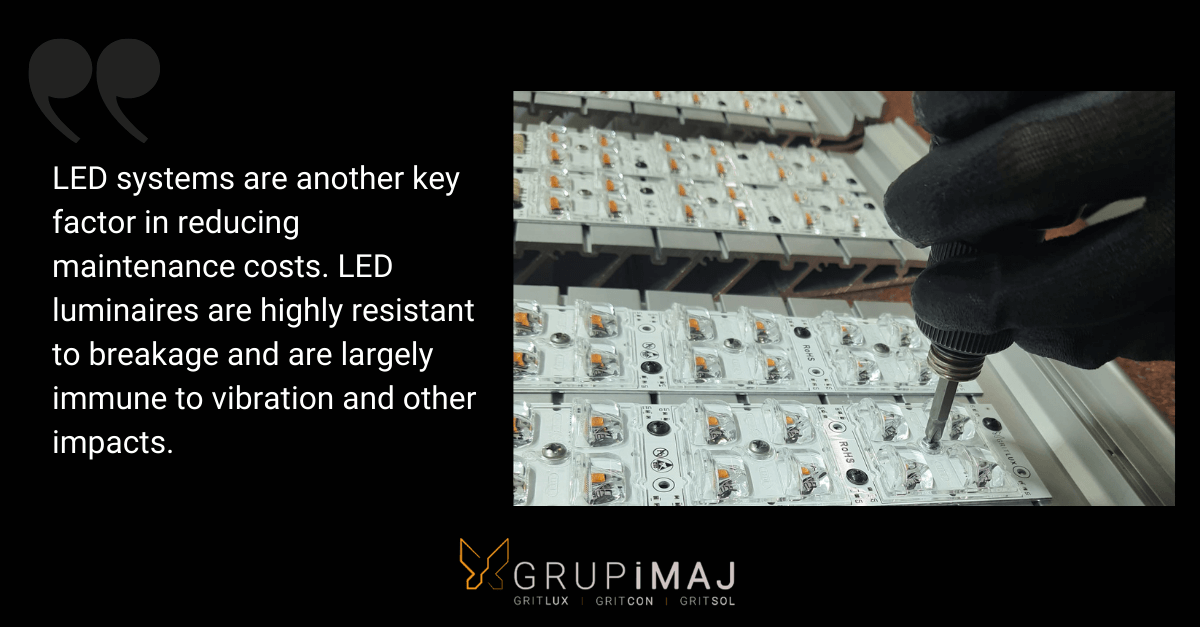
LED systems also help reduce maintenance because they’re built to last. With no fragile filaments or glass enclosures, LED fixtures are far more resistant to breakage and are largely immune to vibration and impact—making them well suited for industrial environments.
Traditional lighting often relies on glass or quartz outer shells, while LEDs are mounted on circuit boards. Their soldered connections can still be sensitive to direct impacts, but generally far less so than conventional lamp structures.
4) Instant-On and Smooth, “Invisible” Dimming
Many fluorescent and HID lamps don’t reach full brightness immediately and may take around three minutes to achieve maximum output. LEDs, by contrast, provide instant 100% brightness with no re-strike delay.
For industrial sites, this can be critical during power interruptions or early-morning operations. With drivers that include astro-dimming features, lighting can also be reduced during low-activity hours—without installing additional systems—quietly maximizing comfort and efficiency.
5) Glare Control
Choosing controllable, dimmable lighting—often with color temperatures of 3000K or lower—and minimizing upward light is a strong foundation for reducing light pollution.
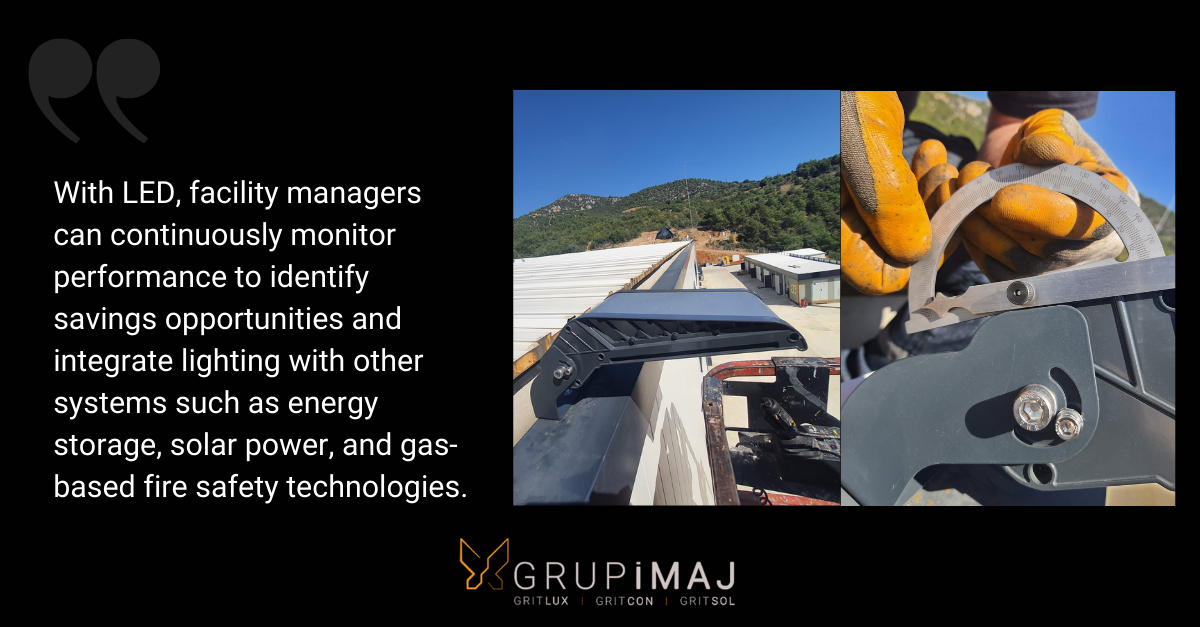
In this application, upward light output is zero, and with appropriate optics the light is directed only to the target area—maximizing uniformity while keeping glare to a minimum. At our facility, the perimeter lighting is 2200K with CRI 70, which improves visual comfort for color recognition while also being less disruptive to insects and other winged wildlife. In addition, with just a 5-degree tilt, light spill beyond our boundary is prevented.
6) A Foundation for Smart Systems
LEDs are semiconductor devices. Yes, they emit light—but they can also become part of a broader intelligent ecosystem. LED systems naturally integrate with advanced controls that can deliver new levels of energy efficiency.
With LEDs, facility managers can continuously monitor performance, identify saving opportunities, and integrate lighting with other systems such as energy storage, solar solutions, and other site technologies.
7) No IR or UV Emissions
With incandescent lamps, less than 10% of the power is converted into visible light; most becomes infrared (IR) radiation and heat. Excess heat and ultraviolet (UV) radiation can be hazardous for people and materials—especially in industrial environments that may include chemicals, complex machinery, and sensitive processes.
Our fixtures used for perimeter lighting emit almost no IR or UV. And as LED technology continues to advance, costs have dropped while reliability has increased.
Even though it’s tempting to assume LEDs are automatically the right choice for every application, the decision should be based on a combination of factors such as light quality and distribution, dimmability, and expected service life.

Get in Touch
For inquiries about our products, technical support, or partnership opportunities, please click the button below to access our contact form. Let’s illuminate your projects together!
Get in Touch
For inquiries about our products, technical support, or partnership opportunities, please click the button below to access our contact form. Let’s illuminate your projects together!